
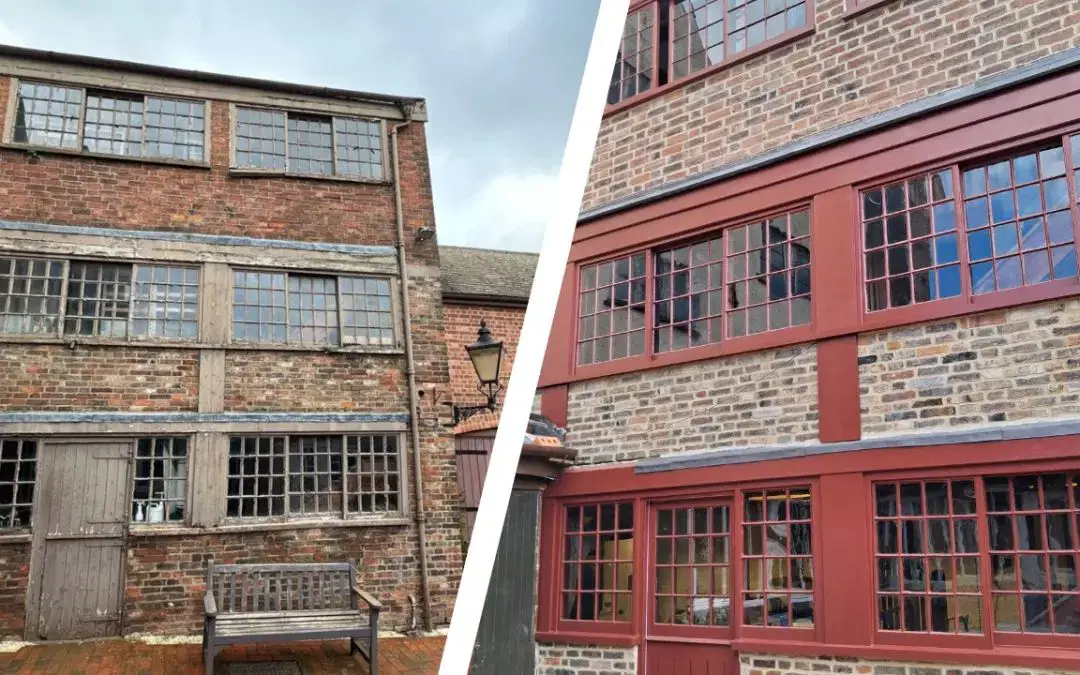
A piece of Gloucester’s history has been successfully restored thanks to the hard work of several heritage organisations working together.
The Pin Factory Annexe, located in the courtyard of The Folk of Gloucester (formerly Gloucester Folk Museum) on Westgate Street, is an important part of Gloucester’s pin manufacturing history. Originally a 16th Century barn, the building was converted into a pin factory in the early 19th Century by local manufacturers Cowcher, Kirby, Beard and Tovey. However, in recent years, its historic sash windows had started to deteriorate, endangering the structural integrity of the building.
Thanks to the advocacy of Gloucester Civic Trust, the Pin Factory Annexe became one of only seven projects in the Southwest chosen to benefit from Historic England’s Heritage at Risk Capital Fund. In January of this year, work began to restore its façade to its original state and re-bed the historic glass windowpanes in era-appropriate frames.
We are so pleased to report that the work, carried out by D A Cook Builders, is now complete. The team came together to carefully, respectfully and professionally renovate this local heritage asset, showing what is possible when dedicated people come together for the same cause. The finished result of the project is quite remarkable and a testament to D A Cook’s expertise in renovating heritage buildings.

Original sign for Kirby, Beard & co pinmakers which hung in 99 Westgate Street © Mike Smith
“We have been patiently waiting for the scaffolding and hoarding to be removed to reveal the hard work that has gone on over the last few months. We were not disappointed! The result is so impressive and has become an excellent example of careful and professional heritage restoration. What’s more important is that we have saved a significant building from being lost, so that it can be appreciated, and its history understood, by future generations,” says Louise Williams, CEO of The Folk of Gloucester.
D A Cook have extensive experience working on historic buildings and have used some historic materials and techniques in the renovation process: for example, traditional lime mortar for the brick pointing. Another of their recent renovation projects was Gloucester Antiques Centre on Westgate Street: a Tudor building whose oldest part dates back to 1470.
Now, the Pin Factory Annexe’s restoration has created safe and attractive surroundings for The Folk of Gloucester’s programme of outdoor events. These include a series of Saturday afternoon “beer gardens” soundtracked by music from different decades. The building’s interior is set to offer more space for events, exhibitions and displays.
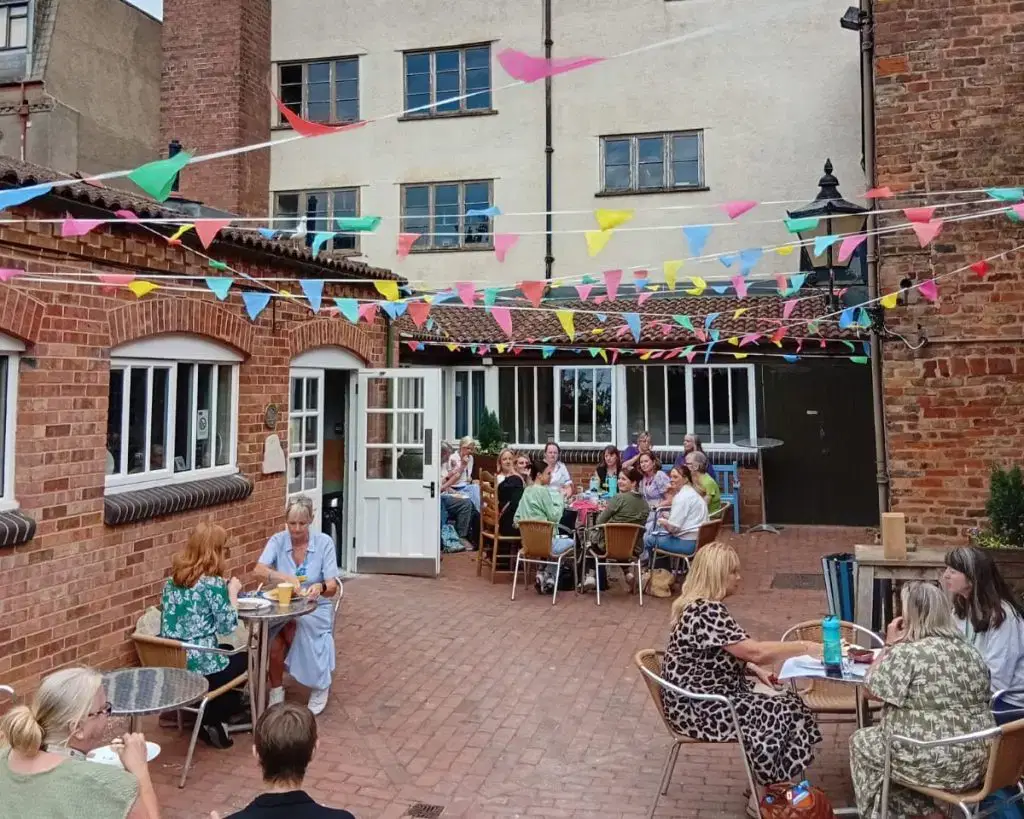
An event in the Folk of Gloucester courtyard © Jo Porlock
Louise Brennan, Director of Regions, Historic England said: “We’re delighted to see the successful completion of these important repairs to the Pin Factory Annexe. This modest building is an important part of Gloucester’s industrial heritage, reflecting the city’s long history of craftsmanship and enterprise.
Funding from Historic England’s Heritage at Risk Capital Fund has enabled vital conservation work to protect the building’s historic character and secure its future. Projects like this show how bringing new life to heritage can create new opportunities for people and communities, helping historic places continue to inspire, connect and serve everyone for generations to come.”
Anyone who wants to find out more is invited to come to the opening on Thursday the 28th of May. From 1pm onwards, Folk of Gloucester volunteer guides will be available to talk about the building and Gloucester’s pinmaking history.